Welding on a Machine that is Equipped with an Electronic Engine Control System
Proper welding procedures are necessary in order to avoid damage to the engine’s electronic control module, sensors, and associated components. The component that requires welding should be removed. When welding on a machine that is equipped with an electronic engine control system and removal of the component is not possible, the following procedure must be followed. This procedure provides the minimum amount of risk to the electronic components.
NOTICE
Do not ground the welder to electrical components such as the ECM or sensors. Improper grounding can cause damage to the drive train bearings, hydraulic components, electrical components, and other components.
Clamp the ground cable from the welder to the component that will be welded. Place the clamp as close as possible to the weld. This will help reduce the possibility of damage.
Stop the engine. Turn the keyswitch to the OFF position.
Disconnect the negative battery cable from the battery. If a battery disconnect switch is installed, open the switch.
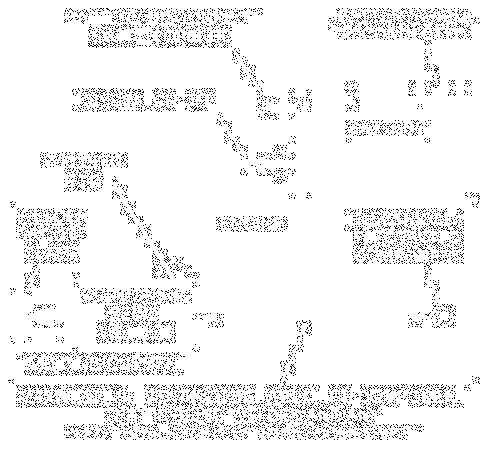 Illustration 1 – The welding current will not cause damage to any of the associated components. Illustration 1 – The welding current will not cause damage to any of the associated components.Connect the welding ground cable as close as possible to the area that will be welded. Components which may be damaged by welding include bearings, hydraulic components, and electrical/electronic components. Protect the wiring harness from welding debris and from spatter. Weld the materials by using standard welding methods. |
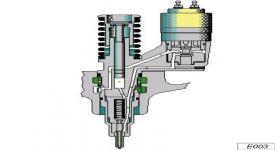 The pumping mechanism is identical to an “In line” or single-cylinder pump. The plunger, which is driven by the camshaft, moves up and down in the body. Fuel, under pressure, moves freely from engine fuel manifold, through the injector, and back into the manifold. At a certain point during the down-stroke, current is applied to the actuator. This current generates a magnetic field within the actuator and causes a high pressure valve to close.